Commercial Trucking Insurance Intelligence

Find trucking insurance opportunities before they hit the market.

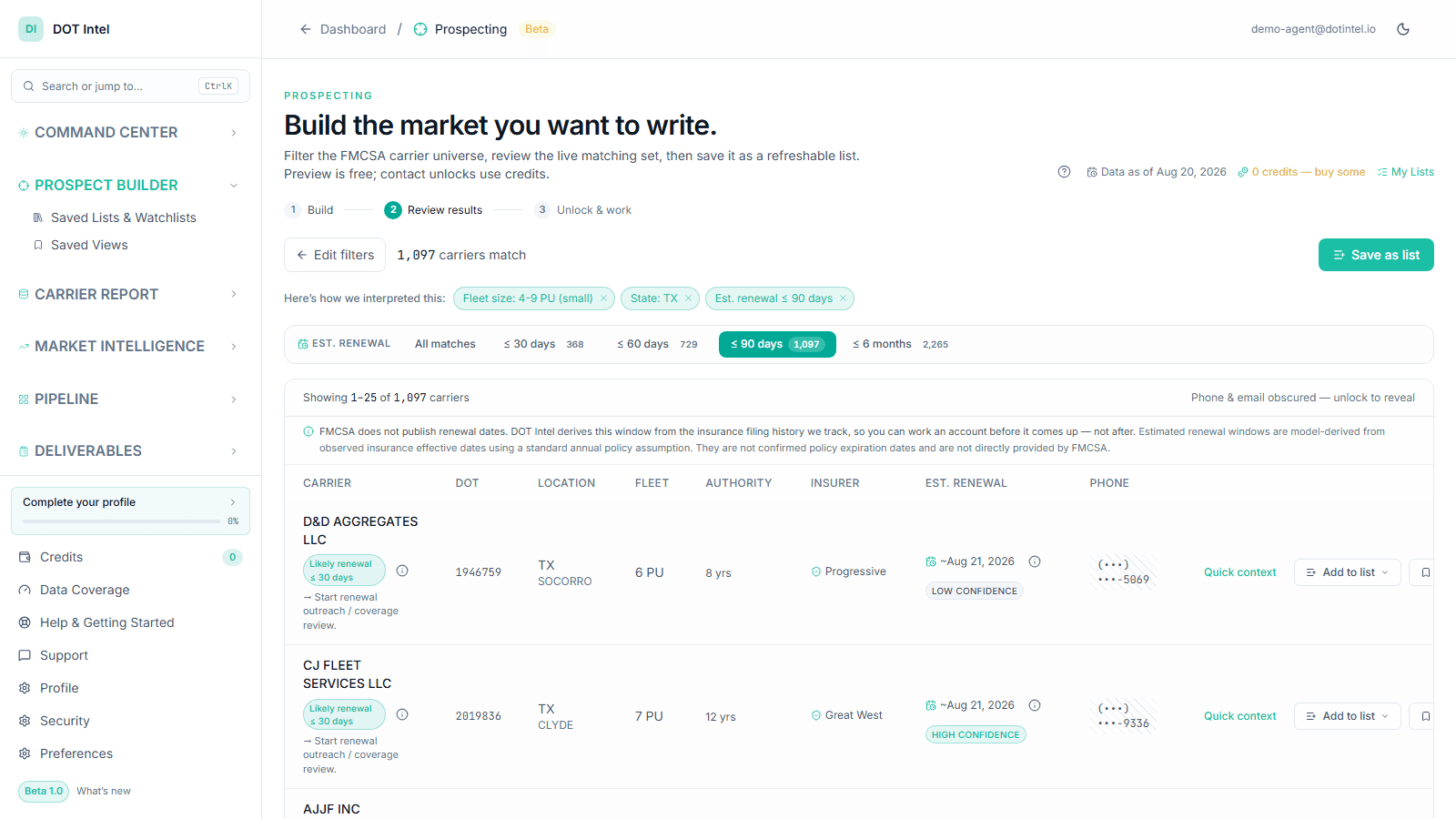
Search FMCSA filing intelligence by state, ZIP, fleet size, insurer, renewal window, and coverage-change signals — then act with clear lead reasons and recommended next steps.

Look up any carrier — free

Free account required · Every USDOT resolves

  • 1.7M motor carriers
  • 350K+ active for-hire
  • Every USDOT resolves

What DOT Intel does

Find leads

Work the renewal window, not a cold list.

Filter by fleet size, state, insurer, and estimated renewal window — then work every quote to a decision.

Free with signup

Start with a USDOT. Find the insurance opportunity.

Every USDOT resolves — all 1.7M FMCSA-registered carriers, not a sample. Look up a motor carrier and see the signals your team needs before prospecting, quoting, underwriting, or routing the opportunity.

Free account required. Already signed up? Log in.

What you get on signup

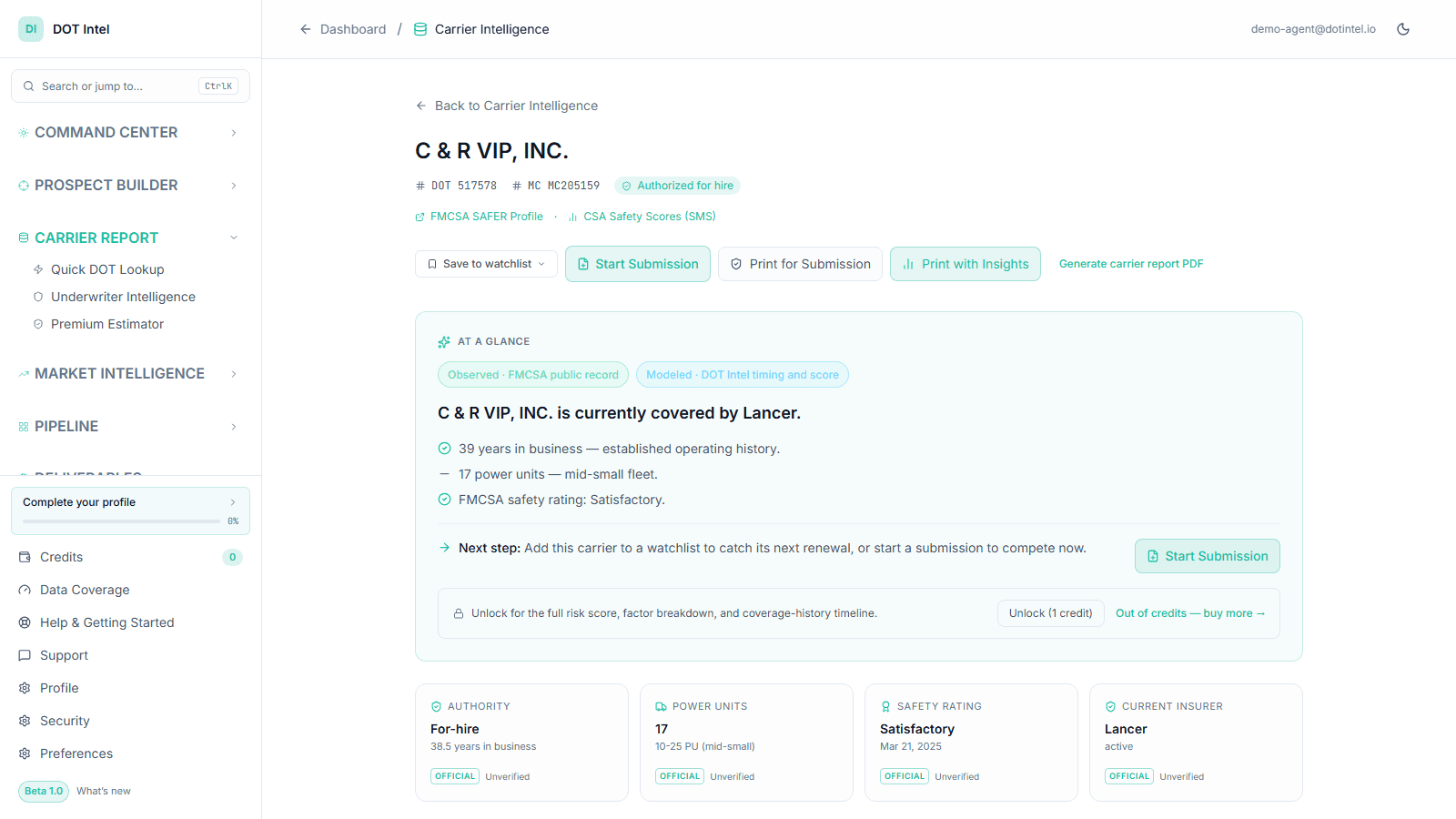
Fleet + authority snapshot

Fleet size, authority status, and current insurer in one view — no tab-switching across FMCSA tools.

Filing history + estimated renewal window

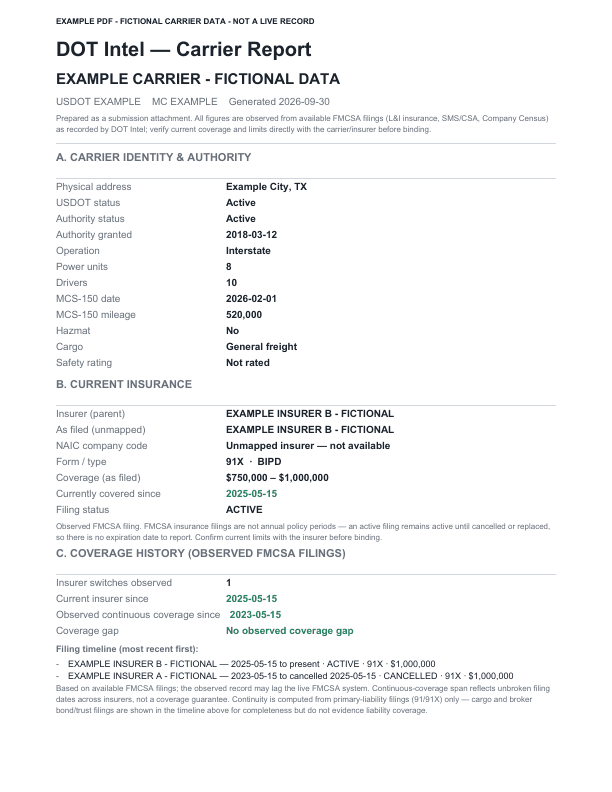
Insurance filings, prior insurer, and coverage effective dates — see which carriers are approaching their renewal window before competitors do.

Safety depth from the public record

CSA BASIC percentiles, a 24-month safety panel, crash history, and coverage continuity — every factor traced to a public FMCSA record, with thin data disclosed rather than scored around. FMCSA's BASIC measures remain the authoritative public safety signal.

Sample carrier report

This is what one USDOT looks like in DOT Intel.

No login required. Enter a real USDOT above to pull the live record — this illustrative example shows the one-view read your team gets: identity, verdict, evidence, and the next best action, every line traced to a public FMCSA record.

Carrier record

Lone Star Freight LLC

USDOT 1234567 · Dallas, TX · Active — for-hire, interstate

As of Aug 12, 2026

Same record, two views

Verdict

Moderate

Very low
Low
Moderate
High
Very high

Screens this account for the underwriting attention it may need before binding — a point-in-time read of the public record, not a forecast over any policy period.

Method & limitations: directional screening indicator from public FMCSA safety and filing data — not a calibrated rate, and has not been backtested against paid claims. Frequency signals only; no severity or loss-cost data is used.

Operating profile

Fleet12 power units
Drivers14 drivers
Operation / radiusGeneral freight · 250-mi radius
Authority granted2016

Coverage & filing

Current insurerProgressive
Prior insurerCanal Insurance
Renewal window~74 days out
Filing on recordBMC-91X · $1M CSL

Federal minimum for general freight: $750K CSL (49 CFR 387.9)

Findings

What's working

  • Continuous coverage on record since 2016, no lapse in the past 24 months.
  • Crash-free in the trailing 12 months.

What concerns me

  • Two BASIC alerts (Unsafe Driving, Hours-of-Service) in the trailing 24 months.

What would stop me

Nothing disqualifying in the public record.

Opportunity

Entering renewal window with a carrier that recently tightened mid-fleet appetite — a fit-matched replacement market is worth a call now.

Next best action

Add to a renewal watchlist, pull the matched-market shortlist, and route to the producer who owns the Dallas territory.

FMCSA public filings (census, L&I authority, insurance) + DOT Intel insurer normalization

Report as of Aug 12, 2026 · DOTINTEL-SAMPLE-1234567

Illustrative example — not a live FMCSA record. Live lookups resolve real carrier data. Premium figures shown anywhere in DOT Intel are illustrative, never a quote.

Look up a real USDOT

The problem

Trucking insurance teams are buried in fragmented data.

FMCSA, SAFER, BASIC, insurance filings, agency directories, fleet census, authority history — the signal exists in public data, but it lives across half a dozen systems with no shared key.

Producers

Chase accounts without knowing fit or renewal timing.

Burn the week researching fleets that won't match a carrier's appetite — power-unit count, garaging state, radius, safety profile, prior carrier — only to learn at submission.

Underwriters

Triage by manual lookup across eight FMCSA tools.

Same eight tabs, every account, every day: USDOT lookup, SAFER, insurance history, BASIC tables, the agency's submission email.

Carrier distribution

Cannot see which agencies and carriers are active in a market.

Territory plans run on anecdotes and stale appointment lists. Where the lift would actually pay off is invisible until someone leaves a competitor.

Territory managers

Rely on stale reports and anecdotal feedback.

Monthly production decks read like last quarter's news. Market share and insurer movement go unanswered between board meetings.

Wholesalers + MGAs

Waste cycles on poor-fit submissions.

Submissions filter back as appetite mismatches. The signal that would have caught it lives in three different agency CRMs, not in the submission.

Product + GTM leaders

Market signals are public, but not organized into action.

The data is there — fleet growth, authority changes, filing updates, appointment patterns. Nobody has time to roll it up into a watchlist before the quarter ends.

DOT Intel turns scattered trucking insurance signals into one intelligence layer.

The platform

From public filings to insurance intelligence.

Four steps that run continuously so your team opens the dashboard and finds the answers, not the raw data.

  1. 01

    Ingest

    Pull FMCSA filings, authority records, insurance history, safety signals, fleet census, agency data, and market records on each source's natural cadence.

  2. 02

    Normalize

    Clean, deduplicate, structure, and map records across carriers, agencies, insurers, locations, and parent companies — 32 insurer parents, 56 children, fleet sizing from active power-unit counts.

  3. 03

    Analyze

    Surface risk signals, renewal timing, prospect fit, agency distribution fit, carrier movement, and territory opportunity. Calibrated against FMCSA's own alert flags before any score is asserted.

  4. 04

    Activate

    Work it all in the built-in Command CRM: personal lead-capture links, a drag-and-drop pipeline, tasks, and daily signals — every lead lands with its full carrier data attached, ready for custom emails and letters. Send from your own agency domain (campaigns and one-off), and build a submission packet you ship to the underwriter in one click. Plus watchlists, reports, prospect lists, and alerts.

One intelligence layer

One intelligence layer. A growth stack around it.

DOT Intel is the platform. DOT Carriers focuses the lookup wedge; Seven16 Mail turns the intelligence into campaigns and survey-qualified prospects that land right back in your Command CRM.

  • DOT Intel

    The parent intelligence platform for trucking insurance strategy.

    Cross-audience hub for producers, underwriters, distribution leaders, MGAs, territory managers, and product teams. Carrier + market intelligence in one surface.

    You are here
  • DOT Carriers

    Motor carrier intelligence for prospecting, underwriting triage, renewal timing, and quote prioritization.

    Carrier-first lookup surface for retail agents, wholesalers, MGAs, and underwriting teams. USDOT-driven; ranked-by-fit prospecting.

  • Seven16 Mail

    Campaigns and surveys for the leads DOT Intel finds — sequences, qualification, and engagement tracking.

    Send campaigns or industry-specific surveys to your prospect lists with your personal DOT Intel capture link inside. Engagement and qualified responses give producers a clearer follow-up path. Seven16 Survey now lives inside Seven16 Mail; the standalone Survey site is retired.

Built for your team

Different teams. Different workflows. One intelligence layer.

Each role gets a starting workflow tuned to the data they need — without rebuilding the same FMCSA + insurance + agency map from scratch.

Producers
Pain
Burning the week researching fleets that won't match any carrier's appetite — power units, garaging state, safety profile — only to find out at submission.
Signal
USDOT lookup surfaces fleet snapshot + insurance history + BASIC exposure + renewal-window flag in one screen. No tab-switching across FMCSA tools.
Action
Run a lookup → save to a renewal watchlist → pull the matched-market shortlist → call the account before competitors see the window.
Underwriters
Pain
The same eight tabs, every account, every day: USDOT lookup, SAFER, insurance history, BASIC tables, the agency's submission email. Manual and slow.
Signal
Carrier intelligence view consolidates the eight tabs into one read: authority, fleet, 24-month BASIC + crash, insurer history, prior carrier, filing count.
Action
Open the carrier-intelligence view → review the 24-month safety panel → route or decline in minutes, not hours.
Wholesalers / MGAs
Pain
Submissions filter back as appetite mismatches. The signal that would have caught it lived in three different agency CRMs, not in the submission.
Signal
Submission-DOT lookup pre-fills carrier fit + safety read in one screen. Match against bound markets' appetite before the submission touches a desk.
Action
Drop a USDOT in the triage view → see fit + risk + market match → accept, decline, or route with a rationale already written.
Carrier Distribution
Pain
Territory plans run on anecdotes and stale appointment lists. Where the lift would actually pay off is invisible until someone leaves a competitor.
Signal
Agency search by state + trucking-focus score + producer contacts. Carrier movement signals show where business is shifting before it shows up in production decks.
Action
Filter agencies by state + trucking-focus tier → export the recruit list → route outreach to producers with the highest appointment fit.
Territory Managers
Pain
Monthly production decks read like last quarter's news. Market share and insurer movement go unanswered between board meetings.
Signal
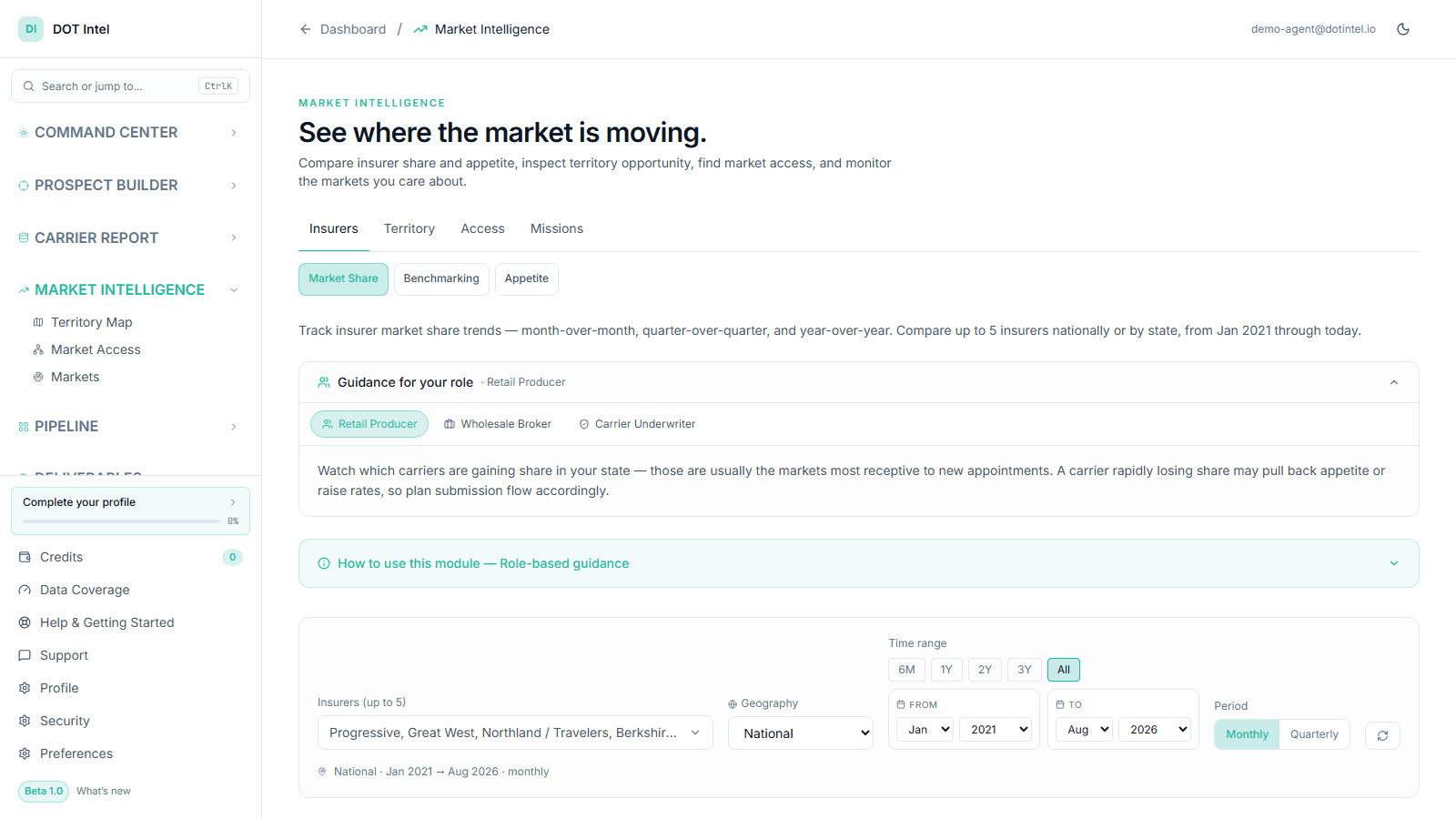
Territory intelligence view by state + class. Filing-update + appointment-signal feeds replace anecdotes with current insurer share, fleet-density shifts, and opportunity ranks.
Action
Open territory intelligence for your state → review the appointment-shift signals → update the territory plan with current data, not last quarter's deck.

Auditable signals

Auditable signals. Reports your team can actually use.

Every signal traces back to public FMCSA filings + insurance records + agency data. Method documented; algorithms version-tagged; nothing fake.

Sample report

CRM + Email (your own domain)

Available now

What it answers

Where do campaign clicks turn into pipeline — and how do I follow up? Capture links land verified leads in the built-in CRM with the carrier's full data attached; you work a drag-and-drop pipeline and send email from your own agency domain, campaigns and one-off alike.

Who uses it

Producers · Agencies

Preview sample report

Sample report

Submission Desk → underwriter

Available now

What it answers

How does a finished submission reach the market? Build the packet — account plus driver, power-unit, and trailer schedules, typed or Excel-imported — then send it to the underwriter from your own domain in one click, workbook attached and logged to the timeline.

Who uses it

Producers · Wholesalers

Preview sample report

Sample report

Motor Carrier Profile

Available now

What it answers

Is this carrier a fit for our markets, what's their authority + fleet + insurance history, and how do they read on the BASIC exposure dimension?

Who uses it

Producers · Underwriters · Wholesalers

Preview sample report

Sample report

Renewal Watchlist

Beta

What it answers

Which carriers in our book or pipeline are entering their renewal window — and when?

Who uses it

Producers · Territory Managers

Preview sample report

Sample report

Agency Match Report

Beta

What it answers

Which agencies in a state write trucking + commercial-auto today, and which producers are the best entry point?

Who uses it

Carrier Distribution · Agency Development

Preview sample report

Sample report

Market Movement Brief

Available now

What it answers

What changed in our territory last week — filings, appointments, fleet shifts, insurer movement?

Who uses it

Product Leaders · Territory Managers

Preview sample report

Sample report

Market Disruption Alert

Available now

What it answers

Which of our accounts are insured with a carrier that just tightened appetite or exited a class — and which replacement markets fit them?

Who uses it

Producers · Wholesalers · MGAs

Preview sample report

Sample report

Chameleon Carrier Detection

Roadmap

What it answers

Is this new venture a reincarnation of a prior revoked or troubled carrier — shared officers, address, phone, or inspected equipment?

Who uses it

Underwriters · MGAs

Preview sample report

Source data + refresh cadence

  • FMCSA records

    Full FMCSA universe — 1.7M motor carriers via MCMIS census + L+I authority files (SODA). 350K+ active for-hire.

  • Authority filings

    OP-1 / MX / FF authority status + history. Active vs revoked/dismissed.

  • Insurance filings

    BMC + BOC-3 filings — 1.89M in a rolling 4-year window across 612K carriers; insurer parent-child rolled across 32 parents and 56 children.

  • Fleet data

    Power units + drivers + operation type from MCMIS census; recomputed on each refresh.

  • Safety signals

    SMS BASIC measures + FMCSA's `_ac` alert flags + crash + inspection counts on a 24-month window.

  • Agency records

    1,887 agencies + 23,546 producer contacts via Seven16 Intel integration; trucking-focus scored.

  • Carrier ↔ insurer mapping

    Current insurer + prior insurer + policy effective date derived from latest BMC filing.

  • Refresh cadence

    Census + authority + current insurance status: daily. Insurance filing history: monthly (FMCSA file cadence). SMS BASIC + safety: monthly. Agency records: weekly.

DOT Intel computes derivative signals (Opportunity Score, Risk Signal, Renewal Window estimate) from public FMCSA filings + insurance records. Each signal is version-tagged and traces to its source data; the exact scoring method is proprietary and internal. DOT Intel is not a federal safety rating system; FMCSA's BASIC measures and `_ac` alert flags remain the authoritative public safety signals.

Illustrative outcomes

Example outcomes from internal pilot data — your results will vary by territory, book, and workflow.

  • Cycle time

    Producer carrier-research time cut from 35 minutes per account to under 3 minutes (illustrative — internal pilot).

  • Submission quality

    Wholesaler decline rate dropped 22% when submissions pre-screen against carrier appetite (illustrative — internal pilot).

  • Territory coverage

    Distribution teams identified 4× more high-fit agency targets per state (illustrative — internal pilot).

Pricing

Browse free. Pay when the intelligence starts working for you.

Public directory browsing and USDOT previews stay free. Standard and Plus unlock full company intelligence, with private preferred pricing for verified FastechHR Network businesses.

Free

$0

USDOT lookups + basic carrier reports

Sign Up

Standard

$59/ mo

Full carrier intelligence + 250 lookups a month

Get started
Most popular

Plus

$119/ mo

1,000 lookups + renewal watchlists + Submission Desk

Get started

14-day evaluation, capped at 25 first-time company intelligence unlocks. Verified Network: $29.50 Standard / $59.50 Plus monthly. Public browsing does not consume actions.

View full pricing

Start now

Turn trucking market data into growth intelligence.

Start with a free USDOT lookup or explore the full DOT Intel platform for carriers, agencies, territories, and market signals.