
Winning the Trucking Insurance Data War
Every agency works the same 1.7 million-carrier universe with the same public data. The ones that grow are the ones that see change first — and act on it in an organized way.
Interview contributor: Ronnie O'Dell, DOT Intel founder.
This guide was developed from interviews with Ronnie and drafted with AI assistance. DOT Intel, a Seven16 Group product, published it. The available record does not identify who finalized the original text or a separate fact-checker or editorial reviewer.
Published . Materially revised .
The dated product examples remain historical; check current product pages before relying on a workflow.
🎧 Listen instead — the 40-minute audio edition
In the truck, on a walk, or between meetings — the full deep-dive discussion of this paper, produced for listening.
How can agencies use carrier changes?
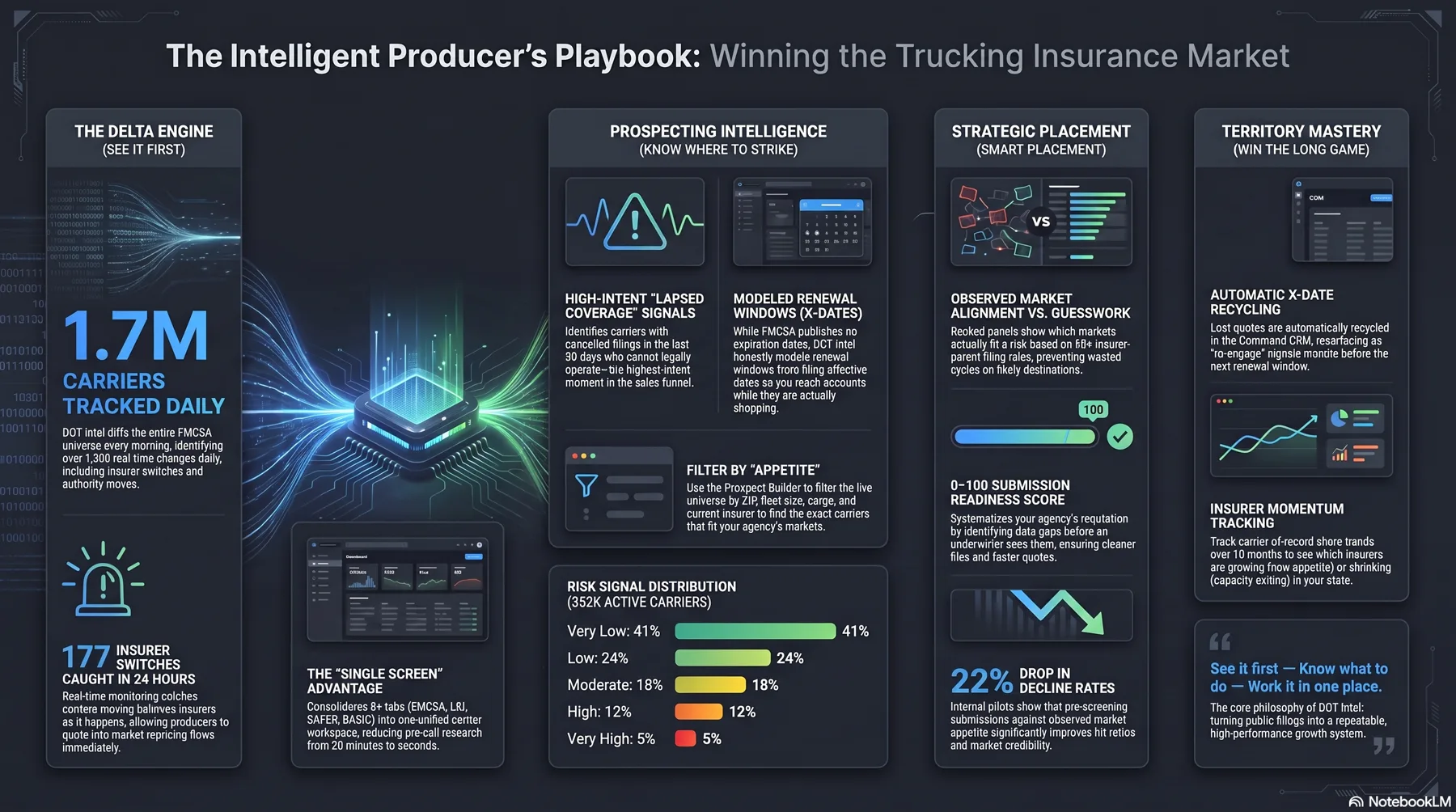
Agencies can use dated FMCSA records to spot a change, verify the carrier, and decide whether a conversation is appropriate. DOT Intel combines public carrier records with internal calculations and modeled signals. A filing change is an observed record; a proposed renewal window or market fit is an estimate that needs independent review.
Which figures appeared in the July 2026 edition?
These are historical DOT Intel internal figures from the original edition. They were not remeasured for this review and should not be used as current market totals.
| Metric | Value | Why it matters |
|---|---|---|
| Registered motor carriers | 1.7M | The full universe every agency competes over |
| Active for-hire carriers | 350,000+ | The core professional prospecting focus |
| Rolling insurance filings | 1.89M (4-yr window) | The observable insurance history layer |
| Insurer families mapped | 56 writing companies → 32 parents | True carrier-of-record share, not paper-name noise |
| Real changes caught, day one | 1,300+ (incl. 177 insurer switches) | The market repricing itself, caught daily |
| Data refresh | Daily | Yesterday's list is already stale |
Market and insurer figures in this guide are carrier-of-record filing counts, not premium share. The public FMCSA records cited below do not provide a policy expiration date. DOT Intel treats a proposed renewal window as a model, not a confirmed date.
Play 1 — Win more accounts: timing × fit
Displacement happens at renewal, and urgency happens at cancellation. The winning play chains four signals so each step compounds: right carrier, right moment, right market, right packet.
| Signal | Nature | Strategic use |
|---|---|---|
| Recently Lost Coverage | Recorded cancellation filing | Review current authority and coverage records before outreach; a cancellation alone does not establish present coverage |
| Likely X-Date window | Modeled estimate with per-carrier confidence | Reach accounts in the weeks they actually shop, before they re-sign |
| Placement Fit | Observed market alignment (60+ insurer-parent rule sets) | Lead with the markets whose filing footprint fits — fewer declinations |
| Readiness score | 0–100 completeness with named gaps | Cleaner submissions get quoted faster and taken seriously |
Play 2 — Strategic marketing: own the segment, not the state
Territory and appetite intelligence show where insurer momentum and uninsured opportunity are concentrated by state, fleet band, and cargo. Point the outreach budget only at those segments, and let saved-search standing reports keep each campaign's audience fresh automatically. Marketing stops being "spray the state" and becomes "own the segment."
Play 3 — Manage accounts: retention as a system
Retention and displacement run on the same signal. Put the book on watchlists and the daily engine flags every cancellation, insurer switch, authority change, and fleet move on your own clients the morning it appears. X-Date recycling closes the loop: every quoted-but-lost account automatically returns to the pipeline before its next renewal — institutional memory that stops living in one producer's head.
Play 4 — Read market & pricing shifts early
Filing counts show observed carrier-of-record changes, not insurer capacity or premium volume. A decline in a market's filings may justify a closer review, but it does not establish that pricing or appetite changed. Compare the time period, carrier population, and underlying filing records before using a trend in a placement conversation.
The tools behind the plays
| Tool | What it does | The payoff |
|---|---|---|
| Carrier Workspace | Authority, fleet, safety, insurer-of-record, filing timeline + risk band on one screen | 20–30 minutes of pre-call research becomes seconds |
| Prospect Builder | Filter the live universe by state, fleet, cargo, insurer, renewal window, cancellation | Pay per carrier you pursue, not per list |
| Daily Alerts & Today's Signals | Every morning's changes on carriers you watch, save, unlock, or work | Hear it from your dashboard, not from the competitor |
| Placement Fit | Ranked market alignment with plain-English reasons and flagged mismatches | Fewer declinations, faster placements, credibility preserved |
| Submission Desk + Readiness | Structured packets with a 0–100 completeness score and named gaps | Your agency's reputation, systematized |
| Command CRM | Trucking-native pipeline with automatic X-Date recycling | Lost quotes become next year's pipeline automatically |
| Reports Library | Readiness-labeled outputs plus a print-ready daily call sheet | Use what works now without mistaking a partial workflow for a finished artifact |
Honesty as strategy
The examples above draw on public FMCSA and filing data, with historical DOT Intel processing described in the original edition. Modeled signals are labeled modeled. Market figures are carrier-of-record counts, not premium. Nothing here is an underwriting decision, a safety rating, or a guarantee of coverage or insurability — it is decision support for professionals, and that discipline is exactly what makes the signals trustworthy enough to build an agency on.
Sources and limits
- FMCSA SAFER Company Snapshot — Look up a carrier by USDOT number and inspect its public snapshot.
- FMCSA Licensing & Insurance carrier search — Inspect public authority and insurance filing records; entry timing can differ from an underlying event.
DOT Intel product counts and historical observations in this paper are internal figures. The linked public records explain the source fields; they do not verify DOT Intel's historical totals or predict a carrier's insurance needs.